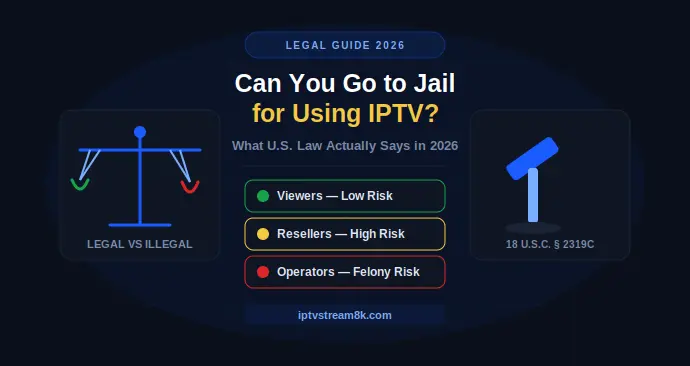
LEGAL GUIDE — UPDATED 2026
Can You Go to Jail for Using IPTV in 2026?
What U.S. Law Actually Says
A clear, fact-checked breakdown — what applies to viewers, resellers, and the people who actually run pirate IPTV operations.
Stream Legally With IPTVStream8K →
⚠️ Not legal advice — see disclaimer at the bottom
If you’ve typed “can you go to jail for using IPTV” into Google, you’re not alone — and you’re asking a smarter question than most people bother with. The honest answer isn’t a simple yes or no. It depends entirely on which side of the IPTV equation you’re on: viewer, reseller, or operator.
This guide breaks down exactly what U.S. federal law says about IPTV in 2026, using the actual statute (18 U.S.C. § 2319C), real prosecutions, and how enforcement has played out — not vague warnings or scare tactics.
⚡ Short answer: Ordinary viewers are extremely unlikely to face jail time. The Protecting Lawful Streaming Act was written specifically to target people who build and sell pirate services for profit — not subscribers. That said, there are real risks for viewers too — just not the kind that put you behind bars.
📋 Quick Navigation
IPTV Itself Isn’t the Problem — Licensing Is
IPTV is just a delivery method. The technology streaming channels through an M3U playlist or Xtream Codes panel is identical whether the content is licensed or stolen. When people ask can you go to jail for using IPTV, they’re really asking about copyright law, not the technology itself.
✅ Licensed IPTV The provider has paid content owners for distribution rights — exactly how YouTube TV, fuboTV, and properly licensed services like IPTVStream8K operate. | ⚠️ Unlicensed (“Pirate”) IPTV The provider re-streams premium channels — ESPN, beIN Sports, HBO — without paying distribution rights. Legally identical to torrenting a movie, even if the channels look the same. |
The most important thing most articles skip: a viewer often can’t tell the difference just by looking at the channel list. A pirate service can offer 50,000+ channels identical to a legitimate one. The legality lives entirely in licensing paperwork you’ll never see.
The Protecting Lawful Streaming Act — The Law That Closed the Loophole
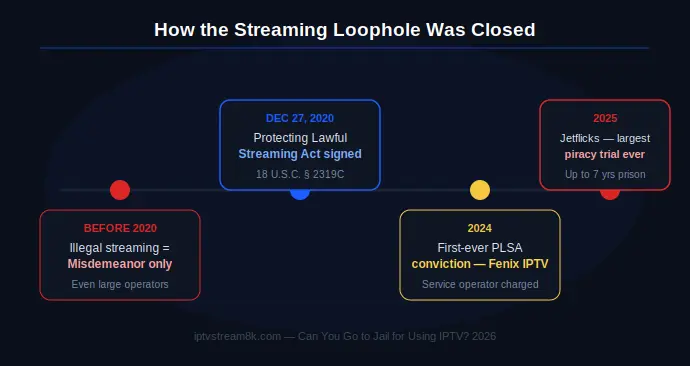
Before December 2020, illegal streaming existed in a genuine legal gray area. Downloading a pirated movie was a federal felony. Streaming that same movie was only a misdemeanor — no matter how large the operation. The Protecting Lawful Streaming Act (PLSA), signed December 27, 2020, closed this loophole by creating a new federal felony at 18 U.S.C. § 2319C.
The statute targets anyone who “willfully, and for purposes of commercial advantage or private financial gain,” operates a digital transmission service primarily built around unlicensed streaming. Maximum penalties reach 10 years federal prison for large-scale offenses.
| Era | Streaming Piracy Classification | Max Penalty |
|---|---|---|
| Before Dec 2020 | Misdemeanor only | 1 year / fines |
| After Dec 2020 | Federal felony under § 2319C (operators/resellers) | Up to 10 years |
| 2026 (viewers) | Civil infringement possible; criminal extremely rare | Civil damages only |
If You’re Just Watching: What’s the Real Risk?
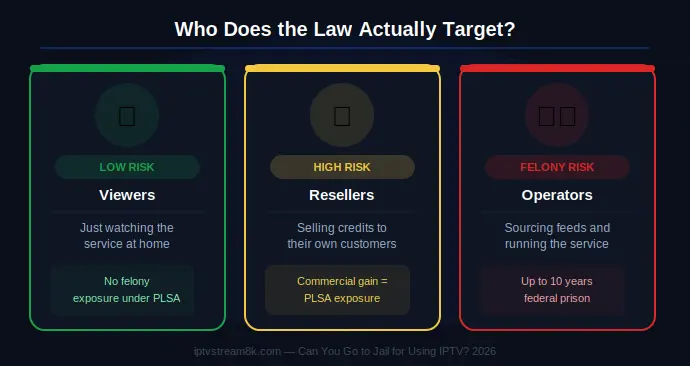
This is where most people land. Can you go to jail for using IPTV as a regular subscriber? Realistically, no. The PLSA’s felony provision requires “commercial advantage or private financial gain.” A subscriber paying $10–$15 a month isn’t providing a service to the public.
What can actually happen to a viewer
- Service seizure / loss of subscription: When authorities shut down a pirate operation, every connected account stops immediately — no refund, no warning. This is the most common real consequence.
- ISP warnings: Internet providers forward copyright notices or throttle connections flagged for suspicious streaming traffic.
- Malware and data theft: Unverified IPTV apps sideloaded outside official stores are a documented vector for malware and credential theft.
- Civil liability (theoretical): Copyright law allows rights holders to sue individual infringers, but pursuing casual home viewers is rare and almost never happens.
- European exception: Germany and France have issued direct fines to individual viewers — something not common in U.S. enforcement.
If You’re Reselling Credits: A Completely Different Risk Tier
IPTV reselling — buying panel credits and selling subscriptions to your own customers — sits squarely inside the PLSA’s “commercial gain” language. A reseller isn’t a middleman avoiding responsibility; if the underlying channels are unlicensed, they’re legally treated as part of the distribution chain.
Civil copyright law also allows statutory damages of up to $150,000 per willfully infringed work — how a single mid-size pirate operation can face judgments in the millions before any criminal charge is filed.
If You’re Operating the Service: This Is Where Jail Time Is Real
Operators — people sourcing pirated feeds and building streaming infrastructure — are exactly who the PLSA was written for. Enforcement since 2020 has matched that intent precisely.
- Up to 10 years federal prison for large-scale or repeat offenses under § 2319C
- Asset seizure of servers, domains, and all financial proceeds
- Civil restitution running into the tens of millions in major cases
- Cross-border prosecution via Mutual Legal Assistance Treaties, even when operators hide offshore
Real Prosecutions — Not Hypotheticals
| Case | Who Was Charged | Outcome |
|---|---|---|
| Fenix IPTV First PLSA conviction | Service operator | First-ever conviction under § 2319C. Re-streamed DISH content via reseller credits sold for $7–$15/month. |
| Jetflicks (2025) Largest piracy trial on record | 5 operators, Las Vegas | 183,000+ pirated episodes. Sentences up to 7 years. $37.5M estimated damages. |
| SET TV Civil action | Service operator | Sued directly by DISH Network for unlicensed redistribution. |
Notice the pattern: every named defendant is an operator or reseller — not a household subscriber. That’s exactly how the statute was drafted and how DOJ has consistently chosen to enforce it.
UK & EU Legal Framework — Different Rules Apply
🇬🇧 United Kingdom
The UK’s Digital Economy Act 2017 created criminal penalties for commercial-scale online piracy with sentences up to 10 years — closely mirroring the PLSA. The Premier League has also secured live blocking orders during match days, making UK ISP-level enforcement more aggressive than the U.S.
🇪🇺 European Union
- Germany: Most aggressive EU enforcement. Law firms have sent mass warning letters (Abmahnungen) to individual viewers with fines of €500–€5,000 per infringement documented.
- France: HADOPI “three-strikes” system — repeated flagged activity can lead to fines and internet suspension.
- Italy: Piracy Shield (2024) enables near-instant blocking of pirate domains, primarily targeting Serie A and Champions League streams.
- Netherlands, Spain, Sweden: Enforcement against individual viewers has been limited; actions focus on operators.
How to Tell If an IPTV Service Is Properly Licensed
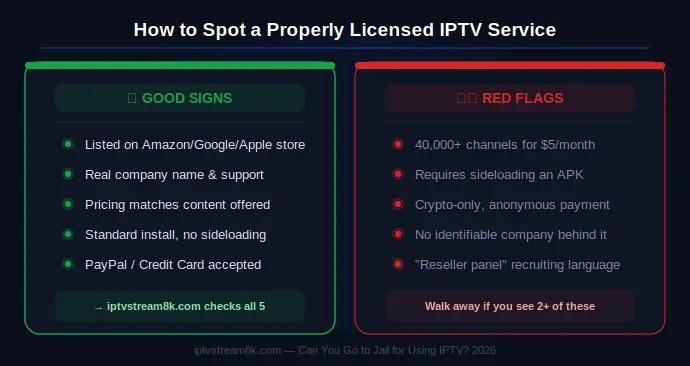
IPTVStream8K ticks all five — proper licensing, transparent pricing from $10.99/month, standard Xtream Codes and M3U setup, PayPal accepted. For a full breakdown of what switching from cable looks like, see our IPTV vs Cable comparison.
Staying on the Right Side of the Law — Practically
- Choose a provider with verifiable licensing. Use the checklist above. A legitimate service will confirm its licensing status directly.
- Never resell credits from an unverified source — even casually or at cost to friends. This single decision is the biggest jump in legal exposure in this entire guide.
- Keep your setup standard. See our guides on best free IPTV apps, IPTV on iPhone, and IPTV Smarters Pro on Windows.
- Don’t confuse “rare prosecution” with “zero risk.” Malware and service instability are immediate costs of unverified providers — separate from any legal question.
- If you’re in Germany or France, take civil warning letter risk more seriously. Viewer-level enforcement is documented there in ways it isn’t in the U.S.
Skip the Gray Area Entirely
IPTVStream8K — properly licensed, transparent pricing, 55,000+ channels, true 4K & 8K. From $10.99/month. No sideloading, no crypto payments, no surprises.
📚 Related Guides
FAQ — Can You Go to Jail for Using IPTV?
The Bottom Line
So, can you go to jail for using IPTV? If you’re a viewer, the real-world risk is your service disappearing without warning and your device being exposed to malware — not handcuffs. If you’re reselling or operating, the calculus changes entirely: federal law, backed by real prosecutions including the largest internet piracy trial on record, treats that as serious criminal exposure with sentences running into years.
The simplest way to remove the question entirely is to use a properly licensed provider. Streaming through a service that’s paid for its content rights costs roughly the same as a budget pirate panel — without the legal ambiguity, the malware risk, or the moment your channels vanish mid-match.
Stream With Total Peace of Mind
IPTVStream8K — licensed content, transparent pricing, 55,000+ channels, true 4K & 8K, no sideloading required. From $10.99/month.